|
|
|
Newspaper Articles August 7, 1881 - The
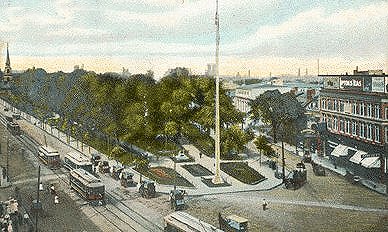
Military Park Fence Garage Newspaper Articles: January 6, 1957 - Newark to Make Parking Surveys From: Newark Street Guide 1872 The largest and finest in the city, lies on the east side of Broad Street, very near its centre, and in its busiest part. In form it is an irregular triangle, contains 6.15 acres, and is handsomely enclosed by an iron railing. Just south of the Park, and opposite the Post Office, the eastern line of Broad Street trends obliquely to the right, forming a triangle of the street itself, with Centre Market on the right and the Morris Canal passing underneath. This is the hay market, an eyesore, soon to be removed. The oblique line of the street on the right, with the enclosure of the Park on the left, extending the entire length of the grounds forms a retired and elegant street, called Park Place. The southern angle of the Park is squared sufficiently to admit of two entrance gateways, supported by four neat iron pillars, and having the flag staff within. The salient features as presented from this point are four avenues of magnificent elms diverging and stretching to the north, the whole fully visible at a glance. Two of these avenues are formed by the streets on either hand, and two are within the Park itself. The long vistas, with the giant limbs and branches of the trees, arched and interlacing over head forms a most agreeable picture. It would be difficult indeed to find anywhere in such a densely populated centre a more bright or cheerful spot. In the middle of the Park an opening is reserved for the evolutions of the military and firing of salutes, the other portions are tastefully planted, the walks flagged, seats conveniently placed and lamps provided to light the grounds at night. We must not forget the English sparrows, of which there are now a large number. They are bright little fellows, very tame and much at home amid the roar of the street. They are sheltered by neat homes amongst the branches and in the clefts of the trees. Near the northern extremity of the Park, facing Broad Street, Trinity Church stands just within the enclosure of the ground. You do not feel its presence to be an intrusion by any means, but rather the contrary, and the clock in its tall spire is a most convenient adjunct. Beyond the church, Rector streets cuts off a small triangular section from the extreme northern point which, with its surroundings and a fine old tree in the centre, form a most agreeable termination to the Park. From: Rider's Newark 1916 Military Park is a long narrow triangle extending southward about three city blocks from the Hudson Tubes. It is bounded by Broad Street on the west and the L-shaped Park Place on the north and east. This park was the original Common and Training Ground, dating from the first foundation of the colony. The park contains the following statues and other memorials: 1. a bronze statue, heroic size of Frederick T. Frelinghuysen (1817-1885), Attorney General of New Jersey, U. S. Senator, and Secretary of State (erected, 1904, by the citizens of Newark, Karl Gerhardt was the sculptor) 2. a life-size bronze statue of Philip Kearny, Brigadier-General in the Civil War and commander of the First New Jersey Brigade, who died in the battle of Chantilly, Sept 1, 1862 (erected 1880, Henry Kirke Brown sculptor) 3. a bronze trophy howitzer, from Morro Castle, at entrance to Santiago Harbor, captured 1898 4. a boulder with the tablet in commemoration of Colonel Peter Schuyler, a New Jersey hero of the French and Indian wars, and of "The Jersey Blues," first uniformed as such by Captain Hart, later a signer of the Declaration of Independence (erected 1916 by the New Jersey group, Society of Founders and Patriots) 5. a stone seat with bronze inscription recording the setting aside of the present park as the town's Training Place, in 1669 (erected, 1916, by the Daughters of the Revolution of New Jersey). In the NW corner of the park stands the venerable old Trinity Church, being in part the original structure erected in 1743-44.
|
||
 |
Copyright 1998 - 2024 Glenn G. Geisheimer |